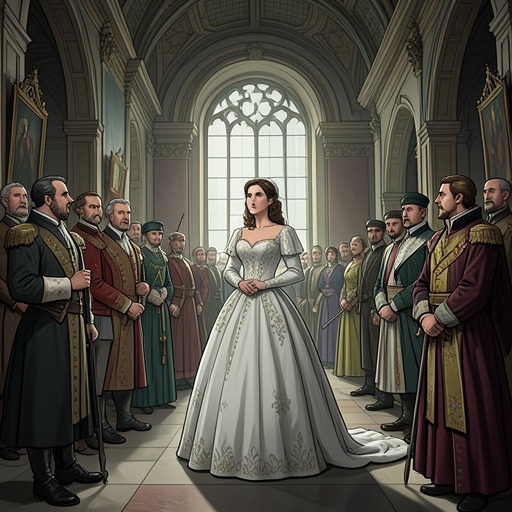
Henry VIII
The King's CurseHenry VIII’s character is shaped by a striking divide: as a boy he speaks of kingship as a divine duty and longs to learn how to govern, but his upbringing shields him from risk and responsibility; as king, he claims sweeping authority, while the losses in his family leave him exposed to grief and fear. His story links the vulnerability of a royal body and dynasty to the power he asserts over the kingdom and the Church.
Identity and Early Formation
At ten, Henry is an exuberant child in the nursery, absorbed by the expected arrival of a bride. He imagines riding up to capture and marry her, impatient with the formal visit planned by his father and older brother. Beneath the boast is an early appetite for action: he turns courtship into a scene of personal initiative, complete with an imagined horse and an audience ready to cheer.
He also imagines a more dutiful future. Kneeling before Margaret Pole, he says he wants to go to Ludlow with her and Richard Pole to learn how to run a country. He describes being born royal as a calling and a destiny, and offers himself for whatever work his father might assign, from ruling Ireland to commanding the navy. His fantasy of greeting his bride in disguise retains the nursery’s theatrical playfulness, but his claim that he means to be a good prince is earnest.
The education he receives does not match that stated ambition. At eleven, Henry remains at Eltham Palace with his sisters rather than being sent away to lead a Welsh household. He has accomplished tutors, musicians, and horsemen, but Margaret Beaufort insists that he be protected from danger. His activities are carefully limited: he may ride only safely prepared horses, practice at the quintain but not joust, and row only when the weather permits. His mother tries to make him a scholar and teach him that a king cannot always have his own way, while Margaret Beaufort’s protection leaves him sheltered from the very tests that might teach self-command.
The Heir and the Accession
Henry’s position as the sole living male Tudor heir makes his childhood protection a matter of dynastic survival. The court treats him as too precious to send away; illness, exertion, and even bad weather are hazards to be managed around him. The narrative emphasizes the tension in this arrangement: Henry is given the privileges of a prince but is not trained to rule himself, even as the continuation of the Tudor dynasty depends on him.
At seventeen, he surprises Margaret Pole. After the old king’s death, his first decisive act is to take the throne and choose Katherine of Aragon as his intended wife. Margaret recalls the contrast between this young king and the nursery boy she had thought a lovable braggart: he moves quickly, joins the acquisition of power to the choice of the woman he loves, and acts with a courage she associates with the House of York. Katherine then summons Margaret to attend her as first lady-in-waiting. The appointment becomes Margaret’s restoration, but it also reveals how closely her place at court is tied to Henry’s decision about the queen.
The earlier arrest of Edmund de la Pole, a Plantagenet duke who had served loyally at the Tudor court, forms part of the political world around Henry’s childhood. Edmund had seemed to embody a reconciliation in which York and Tudor could coexist; his arrest turns that promise into a source of fear. Margaret sees Plantagenet relatives and connections spread across the country, set against a small Tudor family whose future rests on its heirs. This is not presented as Henry’s own action, but it helps explain the fragile dynastic landscape into which he grows.
Marriage, Succession, and Kinship Politics
The question of legitimate succession remains a pressure on Henry’s reign. In Margaret’s account, the court’s hopes rise with each possibility of a male child, while repeated pregnancy losses make the queen’s ability to produce an heir a subject of whispered judgment. A premature labor ends with the birth of a dead girl, extinguishing the hope that a son might transform the queen’s standing and redirect the king’s attention. The episode shows how private childbirth is made to bear public consequences: the queen’s body is treated as a source of dynastic security, and the prospect of a male heir shapes the status of the women around Henry.
The death of an infant prince brings that pressure into the nursery itself. The child, whom the king had entrusted to Margaret to raise as a future king, dies suddenly, with the nurse having noticed only that he had become unusually quiet. Margaret is called first and carries the news into the queen’s chamber. The episode gives no political remedy for the loss; its force lies in the abrupt collapse of expectation, as the succession crisis becomes a personal bereavement within the royal household.
Later, Margaret and her sons understand their extended kinship network as both a source of solidarity and a political danger. Marriage joins their lands, wealth, and influence, but the same dense connections can be interpreted suspiciously as a faction or conspiracy. Montague proposes that Geoffrey Pole travel with him to Calais and then carry information to Reginald Pole, including a message for the Pope and a letter for the queen’s nephew, the King of Spain. He hopes a papal ruling will compel Henry to restore the queen and halt the king’s course. This is Montague’s plan, not an action Henry is shown taking, but it makes clear how resistance to the king is organized through family ties and appeals to competing authorities.
Montague argues that Henry is presenting Henry FitzRoy as an heir and may therefore put Princess Mary aside. He and Geoffrey call on the Plantagenets to defend the queen and princess and to bring Henry back to what they regard as his proper inheritance. Margaret’s response is divided: she has a duty to the queen and the princess in her care, but also remembers that she taught Henry to walk, loved his mother, Elizabeth of York, and promised to protect her sons. Her attachment to Henry does not prevent her from opposing what she sees as his destruction of the princess’s rights and his own inheritance.
Royal Authority and the Church
Henry’s authority expands beyond dynastic politics into the governance of religion. When the Church surrenders to the king, Montague reports that the Pope is to be disregarded in England and that Henry will rule the Church himself. Thomas More returns the Lord Chancellor’s seal and resigns. Princess Mary recognizes the scale of the change: she understands that the king’s claim reaches not only church wealth but its laws and courts, placing the Church within his possession.
The episode marks a sharp change in the terms of kingship. Henry’s childhood language of a divine calling becomes, in practice, a claim to rule over institutions that had been subject to papal authority. For those around him, the change leaves little space to challenge the king. Montague’s proposed appeal to the Pope is an attempt to use an authority outside Henry’s reach, while Margaret’s account underscores the danger of opposing a ruler who can redefine the boundaries of both political and religious obedience.
Grief, Majesty, and Vulnerability
Henry’s claim to enlarged authority contrasts with his response to the death of Henry FitzRoy, his son by Elizabeth Blount, whom he calls Richmond. In his grief, Henry asks Margaret whether there is a curse against him and why he has lost those he loves. He links the loss of his son to the prospect of divine punishment, asking what Elizabeth Blount or Richmond had done to deserve it. The questions reveal a king seeking an explanation that his political power cannot supply.
The title of Majesty makes this contrast visible. Henry has adopted an imperial style after becoming the sole ruler in England and asserting authority over the Church; yet, overcome by grief, he must be helped from the floor into bed. Six attendants are needed to lift him, and the household hesitates over how to approach him. The routines of royal care continue around this unsteady figure, but they cannot restore his composure. Henry’s arc thus sets the reach of his office against the limits of his body and private life: the king can claim to govern a kingdom and its Church, yet he cannot command the losses that lead him to fear a curse.